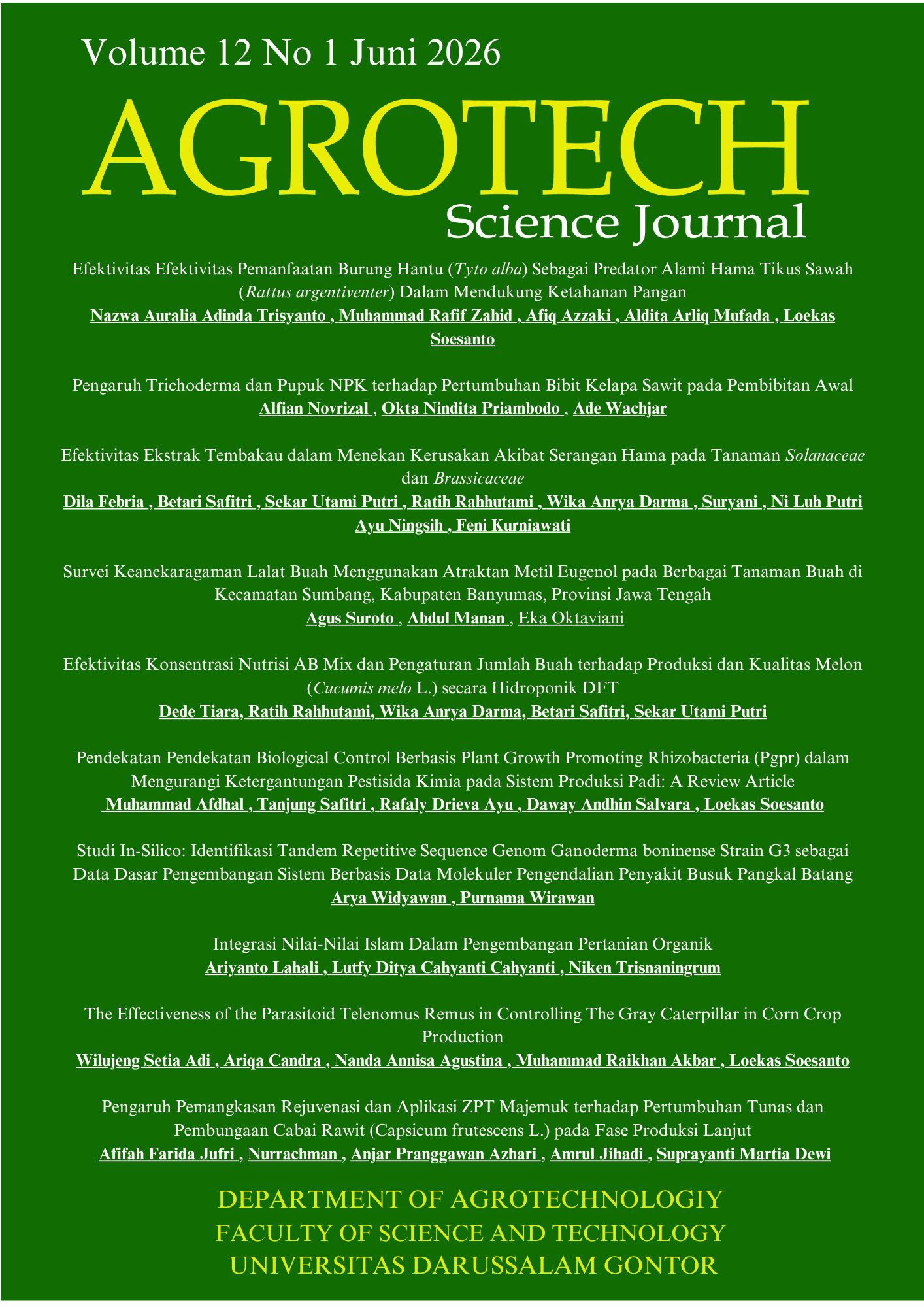
Efektivitas Ekstrak Tembakau dalam Menekan Kerusakan Akibat Serangan Hama pada Tanaman Solanaceae dan Brassicaceae
Effectiveness of Tobacco Extract in Suppressing Pest Damage in Solanaceae and Brassicaceae Crops
DOI:
https://doi.org/10.21111/agrotech.v12i01.16Keywords:
pestisida nabati, cabai, kembang kol, tomat, kutu kebul.Abstract
Tanaman tomat, cabai, dan kembang kol merupakan komoditas hortikultura strategis yang rentan terhadap serangan berbagai hama utama seperti kutu kebul, thrips, Plutella xylostella dan kutu daun. Pengendalian masih bergantung pada pestisida sintetis yang dilaporkan menimbulkan berbagai dampak negatif seperti resistensi hama, resurjensi, pencemaran lingkungan, serta residu berbahaya sehingga diperlukan alternatif pengendalian yang lebih ramah lingkungan. Ekstrak tembakau (Nicotiana tabacum) yang mengandung senyawa aktif nikotin, alkaloid, flavonoid, dan saponin berpotensi sebagai pestisida nabati karena terbukti efektif menekan populasi dan kerusakan akibat serangan hama pada tanaman Solanaceae dan Brassicaceae, sehingga berpeluang mendukung sistem budidaya hortikultura berkelanjutan. Penelitian dilakukan di Kebun Percobaan dan Praktikum Hortikultura, Politeknik Negeri Lampungpada bulan Juni hingga November 2025 dengan bahan yang digunakan dalam penelitian ini adalah tomat Gustavi F1, cabai Kopay, kembang kol East West Seed PM 3000 serta daun tembakau yang dikeringkan. Sebanyak 250 gram daun tembakau kering direndam dalam 5 liter air selama 24 jam. Pengaplikasian dilakukan dengan 250 ml air rendaman daun tembakau dicampurkan kedalam 5 liter air dan diaplikasikan dua kali seminggu. Pengamatan dilakukan dengan menghitung populasi hama dan intensitas kerusakan akibat serangan hama. Pengaplikasian pestisida nabati berbahan daun tembakau efektif menurunkan intensitas kerusakan pada daun tanaman cabai sebesar 35,30%, pada tanaman tomat sebesar 68,93% dan pada tanaman kembang kol sebesar 46%. Oleh sebab itu, pemanfaatan ekstrak tembakau berpotensi menjadi alternatif pengendalian hama yang lebih aman dan mendukung penerapan sistem pertanian berkelanjutan.
References
Abdurrahman, S. G., Ikawati, S., Choliq, F. A., & Mustofa, O. (2024). Bioaktivitas ekstrak limbah tembakau sebagai pestisida nabati terhadap Plutella xylostella pada tanaman kubis. Jurnal Hama dan Penyakit Tumbuhan, 12(2), 91–102.
Campbell, P. R., Cremer, J. E., Roach, R. L., Steele, V., Subramaniam, S., Sivasubramaniam, V., Monsour, C., Mullins, T., Persley, D. M., Gambley, C. F. (2017). Toward area wide management of insect vectored viruses of tomatoes in the Bowen District. Elsevier. Vol 241, 15 September 2017, Pages 228-235.
Campos, E. V. R., de Oliveira, J. L., Pascoli, M., de Lima, R., & Fraceto, L. F. (2019). How can nanotechnology help to improve the development of insecticides? Environmental Chemistry Letters, 17(1), 295–315.
Cao, X., Huang, M., Wang, S., Li, T., & Huang, Y. (2024). Tomato yellow leaf curl virus: Characteristics, influence, and regulation mechanism. Plant Physiology and Biochemistry, 213, 108812. https://doi.org/10.1016/j.plaphy.2024.108812
Dubey, N. K., Shukla, R., Kumar, A., Singh, P., & Prakash, B. (2011). Prospects of botanical pesticides in sustainable agriculture. Current Science, 100(4), 479–480.
Febria, D. (2015). Karakterisasi Virus Penyebab Penyakit Tanaman Cabai (Capsicum sp.) pada Tiga Kondisi Geografis. 2015. Tesis. Sekolah Pascasarjana Universitas Gadjah Mada. Yogyakarta. 86 hal.
Febria, D., Safitri, B., Prajaka, N. W., Yeni, Y., Kartina, R., & Putri, S. U. (2023). Karakteristik gejala dan tingkat kejadian penyakit kuning keriting tanaman cabai (Capsicum sp.) dalam budidaya sistem organik. Journal of Horticulture Production Technology, 1(2), 95–101.
Isman, M. B. (2020). Botanical insecticides in the twenty-first century—Fulfilling their promise? Annual Review of Entomology, 65, 233–249.
Januarisya, M. A., Rahardjo, B. T., Syamsulhadi, M. (2023). Keanekaragaman hama dan musuh alami pada budidaya cabai rawit monokultur dan polikultur dengan memanfaatkan tanaman perangkap baby blue dan yellow sticky trap. Jurnal HPT. Vol. 11. No. 4 201-216.
Kardinan, A. (2011). Pestisida nabati: Ramuan dan aplikasi. Penebar Swadaya.
Kementerian Pertanian Republik Indonesia. (2023). Statistik hortikultura 2023. Direktorat Jenderal Hortikultura, Kementerian Pertanian RI.
Kenyon, L., Kumar, S., Tsai, W. S., & Hughes, J. d’A. (2014). Virus diseases of peppers (Capsicum spp.) and their control. Advances in Virus Research, 90, 297–354.
Lengai, G. M. W., Muthomi, J. W., & Mbega, E. R. (2020). Phytochemical activity and role of botanical pesticides in pest management for sustainable agricultural crop production. Scientific African, Vol 7. (1-13)
Lestari, D., Prasetyo, A., & Wijayanti, R. (2025). Dampak penggunaan pestisida sintetis terhadap kesehatan dan lingkungan pertanian. Jurnal Pertanian Berkelanjutan, 7(1), 12–21.
Listiyani, E. D. (2025). Penerapan biopestisida nabati untuk pertanian ramah lingkungan dalam meningkatkan hasil dan keseimbangan ekosistem. Jurnal Ilmu-Ilmu Pertanian. Vol. 32 No. 1, Page 64-74.
Mossa, A. T. H. (2016). Green pesticides: Essential oils as biopesticides in insect-pest management. Journal of Environmental Science and Technology, 9(5), 354–378.
Navas-Castillo, J., Fiallo-Olivé, E., & Sánchez-Campos, S. (2011). Emerging virus diseases transmitted by whiteflies. Annual Review of Phytopathology, 49, 219–248.
Ngegba, P.M., Cui, G., Khalid, M.Z., Zhong, G. 2022. Use of botanical pesticides in agriculture as an altervative to synthetic pesticides. Agriculture. Vol 12(5), 600; https://www.mdpi.com/2077-0472/12/5/600?utm
Nicolopoulou-Stamati, P., Maipas, S., Kotampasi, C., Stamatis, P., & Hens, L. (2016). Chemical pesticides and human health: The urgent need for a new concept in agriculture. Frontiers in Public Health, 4, Article 148.
Okagu, I. U., Okeke, E. S., Ezeorba, W. C. F., Aguchem, R. N., & Anuforo, P. C. (2023). Overhauling the ecotoxicological impact of synthetic pesticides using plants’ natural products: A focus on Zanthoxylum metabolites. Environmental Science and Pollution Research, 30(30), 67997–68021.
Oliveira, M. R. V., Henneberry, T. J., & Anderson, P. (2001). History, current status, and collaborative research projects for Bemisia tabaci. Crop Protection, 20(9), 709–723.
Pavela, R., & Benelli, G. (2016). Essential oils as ecofriendly biopesticides? Challenges and constraints. Trends in Plant Science, 21(12), 1000–1007.
Popp, J., Pető, K., & Nagy, J. (2013). Pesticide productivity and food security: A review. Agronomy for Sustainable Development, 33(1), 243–255.
Rosandy, D. F., Syamsulhadi, M., & Widjayanti, T. (2024). Uji mortalitas Metarhizium anisopliae dan ekstrak tembakau terhadap Plutella xylostella pada tanaman kubis. Jurnal Hama dan Penyakit Tumbuhan, 12(2), 77–90.
Safitri, B., Putri, S. U., Febria, D., Darma, W. A. (2024). Intensitas serangan kutu kebul pada tanaman tomat dengan pemberian pestisida nabati berbahan dasar daun tembakau. Gontor Agrotech Science Journal, 10(2), 165-172.
Safitri, B., Febria, D., Putri, S.U., Darma, W.A. (2025). Infestation of aphids in tomato plantations after application of tobacco leaves mixtures with other botanical insecticides. JERAMI (Indonesian Journal of Crops Science). Vol 8(1) 24-30.
Sarfraz, M., Keddie, B. A., & Dosdall, L. M. (2005). Biological control of the diamondback moth, Plutella xylostella: A review. Biocontrol Science and Technology, 15(8), 763-789.
Sastrosiswojo, S., & Setiawati, W. (2021). Hama penting tanaman hortikultura dan teknik pengendaliannya. Balai Penelitian Tanaman Sayuran.
Smith, C. M., et al. (2021). Synthetic pesticides and ecotoxicological implications in agroecosystems. Environmental Toxicology and Chemistry, 40(5), 1201–1215.
Untung, K. (2018). Pengantar pengelolaan hama terpadu. Gadjah Mada University Press.
Zuhro, F. 2024. Senyawa anti feedant : Mekanisme kerja daan perannya sebagai senyawa anti pestisida. Jurnal Biosapphire. Vol. 3 No. 2 page 98-108.
Downloads
Submitted
Accepted
Published
How to Cite
Issue
Section
License
Copyright (c) 2026 Gontor Agrotech Science Journal

This work is licensed under a Creative Commons Attribution 4.0 International License.